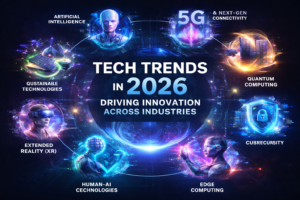
The year 2026 marks a significant phase in technological evolution, where emerging innovations are not only advancing individual sectors but also reshaping the global economy. Rapid developments in artificial intelligence, connectivity, sustainability, and digital infrastructure are transforming how businesses operate and how people interact with technology. These trends are interconnected, creating a powerful ecosystem that drives efficiency, productivity, and innovation across industries.
Understanding these key technology trends is essential for organizations and professionals aiming to remain competitive in a fast-changing digital landscape.
Artificial Intelligence and Autonomous Systems
Artificial Intelligence (AI) continues to be one of the most influential technologies in 2026, evolving beyond automation into intelligent decision-making systems. AI is now deeply embedded in industries such as healthcare, finance, manufacturing, and retail, enabling faster data analysis and improved operational efficiency. Machine learning models are becoming more accurate, adaptive, and capable of handling complex tasks.
Autonomous systems, including self-driving vehicles, drones, and robotic process automation, are also gaining widespread adoption. These systems reduce human intervention, increase safety, and lower operational costs. Businesses are leveraging AI not only for automation but also for predictive analytics, customer personalization, and strategic planning, making it a cornerstone of modern innovation.
Expansion of 5G and Next-Gen Connectivity
The global expansion of 5G networks in 2026 is revolutionizing connectivity by offering faster speeds, lower latency, and more reliable communication. This advancement is enabling real-time data transfer, which is crucial for technologies like autonomous vehicles, smart cities, and remote healthcare services. Enhanced connectivity is also supporting the growth of the Internet of Things (IoT), where billions of devices communicate seamlessly.
Beyond 5G, research into next-generation networks is already underway, promising even greater capabilities. These advancements are transforming industries by enabling immersive experiences such as augmented reality (AR) and virtual reality (VR). As connectivity improves, businesses can operate more efficiently, and consumers can access richer, more interactive digital services.
Rise of Quantum Computing
Quantum computing is emerging as a transformative force in 2026, with the potential to solve complex problems that are beyond the reach of traditional computers. Industries such as pharmaceuticals, logistics, and finance are exploring quantum solutions to optimize processes and accelerate innovation. This technology leverages quantum bits (qubits) to perform calculations at unprecedented speeds.
While still in its early stages, quantum computing is showing promise in areas like drug discovery, cryptography, and climate modeling. Companies and governments are investing heavily in research and development to unlock its full potential. As the technology matures, it is expected to redefine computational capabilities and create new opportunities across industries.
Sustainable and Green Technologies
Sustainability has become a central focus in technological development, with green technologies driving innovation in 2026. Businesses are adopting eco-friendly practices and investing in renewable energy solutions to reduce their carbon footprint. Technologies such as energy-efficient data centers, electric vehicles, and smart grids are gaining momentum.
In addition, advancements in materials science are enabling the creation of sustainable products and packaging. Organizations are leveraging technology to monitor and optimize resource usage, contributing to environmental conservation. This trend reflects a growing commitment to balancing economic growth with environmental responsibility, making sustainability a key driver of future innovation.
Growth of Extended Reality (XR)
Extended Reality (XR), which includes augmented reality (AR), virtual reality (VR), and mixed reality (MR), is transforming how people interact with digital content. In 2026, XR technologies are being widely used in education, healthcare, gaming, and training environments. These immersive experiences enhance learning, improve engagement, and provide realistic simulations.
Businesses are adopting XR for product design, remote collaboration, and customer experiences. For example, virtual showrooms and interactive product demonstrations are becoming common in retail. As hardware becomes more affordable and software more sophisticated, XR is expected to play a significant role in shaping the future of digital interaction.
Cybersecurity and Data Privacy Innovations
With the increasing reliance on digital systems, cybersecurity has become more critical than ever in 2026. Organizations are investing in advanced security technologies to protect sensitive data from cyber threats. AI-driven security systems are being used to detect and respond to threats in real time, enhancing overall protection.
Data privacy is also gaining importance as regulations become stricter and consumers demand greater control over their information. Companies are implementing robust data governance frameworks and encryption technologies to ensure compliance and build trust. As cyber threats evolve, continuous innovation in cybersecurity is essential to safeguard digital ecosystems.
Edge Computing and Decentralized Infrastructure
Edge computing is gaining traction as a solution to handle the growing volume of data generated by connected devices. Instead of relying solely on centralized cloud systems, data is processed closer to its source, reducing latency and improving efficiency. This approach is particularly beneficial for applications requiring real-time responses, such as autonomous systems and smart manufacturing.
Decentralized infrastructure, including blockchain technology, is also playing a significant role in enhancing transparency and security. These systems reduce dependency on central authorities and enable secure peer-to-peer transactions. Together, edge computing and decentralization are reshaping how data is managed and utilized across industries.
Human-AI Collaboration and Workforce Transformation
The relationship between humans and technology is evolving, with a strong focus on collaboration rather than replacement. In 2026, AI is augmenting human capabilities by assisting in decision-making, problem-solving, and creative processes. This shift is transforming the workforce and creating new job roles that require digital skills.
Organizations are investing in upskilling and reskilling initiatives to prepare employees for the future of work. Hybrid work models, supported by advanced digital tools, are becoming the norm. This trend highlights the importance of adaptability and continuous learning in a technology-driven world.
Conclusion
The technological landscape in 2026 is defined by rapid innovation and interconnected advancements that are transforming industries on a global scale. From artificial intelligence and quantum computing to sustainable technologies and advanced connectivity, these trends are shaping the future of business and society.
As organizations embrace these innovations, they must also address challenges related to security, ethics, and workforce transformation. The ability to adapt and integrate emerging technologies will determine success in this evolving digital era. By staying informed and proactive, businesses and individuals can harness these trends to drive growth, efficiency, and meaningful progress in the years ahead.