Cloud technology has become one of the most transformative innovations in the modern digital economy. Over the past decade, advancements in cloud computing have enabled businesses to store data, run applications, and collaborate across global networks without relying on traditional on-premise infrastructure. As organizations continue to embrace digital transformation, cloud technology plays a critical role in improving efficiency, flexibility, and scalability.
The growth of remote work, particularly after global disruptions in recent years, has accelerated the adoption of cloud-based tools and platforms. Businesses now rely heavily on cloud services to support distributed teams, manage large volumes of data, and maintain seamless communication. By providing secure, accessible, and scalable solutions, cloud technology has become a fundamental pillar supporting modern business operations and remote working environments.
Understanding the Fundamentals of Cloud Technology
Cloud technology refers to the delivery of computing services—including storage, servers, databases, networking, and software—over the internet rather than through local hardware. Instead of purchasing and maintaining expensive infrastructure, organizations can access these resources on demand through cloud service providers.
This approach allows businesses to scale their computing resources based on their needs. For example, a company experiencing rapid growth can easily increase its storage capacity or computing power without investing in new physical equipment. This flexibility makes cloud computing particularly valuable for startups and growing enterprises that require adaptable technology solutions.
Another key advantage is accessibility. Cloud systems allow employees to access business data and applications from virtually any location using an internet connection. This capability has significantly improved productivity and collaboration, especially for organizations with remote or globally distributed teams.
The Role of Cloud Technology in Enabling Remote Work
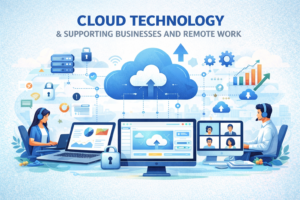
Cloud technology has been instrumental in enabling the global shift toward remote work. Traditional office-based systems often required employees to be physically present to access company networks or files. Cloud-based platforms eliminate these limitations by allowing secure remote access to essential tools and resources.
Employees can now collaborate through cloud-hosted communication platforms, project management tools, and document-sharing services. These systems allow team members to work on the same files simultaneously, track project progress, and communicate in real time regardless of geographic location.
The flexibility provided by cloud technology has allowed businesses to maintain continuity even during disruptions that prevent physical office access. Organizations can operate smoothly with distributed teams while maintaining high levels of productivity and coordination.
Cloud-Based Collaboration Tools and Productivity
One of the most visible benefits of cloud advancements is the development of collaborative digital workspaces. Modern cloud platforms offer integrated solutions for communication, document management, and workflow automation.
Cloud-based collaboration tools allow employees to share documents, edit files simultaneously, and store project data in centralized locations. This ensures that team members always have access to the most updated information, reducing confusion caused by multiple document versions.
These tools also enhance productivity by integrating features such as video conferencing, task management, and team messaging. By bringing communication and project coordination into a single digital environment, cloud platforms help teams work more efficiently and stay aligned with organizational goals.
Scalability and Cost Efficiency for Businesses
Another major advantage of cloud technology is its ability to provide scalable solutions that align with business growth. Traditional IT infrastructure requires companies to purchase hardware and software that may become outdated or underutilized over time. Cloud services allow businesses to pay only for the resources they actually use.
This pay-as-you-go model reduces upfront costs and allows organizations to allocate financial resources more effectively. Businesses can easily adjust their usage levels during peak periods or scale down when demand decreases.
Cloud scalability is particularly beneficial for industries that experience fluctuating workloads, such as e-commerce, digital media, and technology startups. By adapting resources to real-time demand, companies can maintain optimal performance without overspending on infrastructure.
Security Improvements in Modern Cloud Systems
Security has always been a major concern for organizations handling sensitive data. Cloud technology providers have made significant advancements in cybersecurity measures to protect user information and maintain data integrity.
Modern cloud systems employ advanced encryption methods, identity management tools, and multi-factor authentication to secure digital assets. These security measures help protect data both during storage and transmission.
In addition, many cloud providers offer automated security monitoring and threat detection systems. These technologies can identify potential vulnerabilities or suspicious activities in real time, allowing organizations to respond quickly to cybersecurity threats.
For businesses with limited internal IT resources, cloud-based security services provide an additional layer of protection that would otherwise be difficult to implement independently.
Cloud Computing and Business Innovation
Cloud technology also plays a key role in supporting innovation and digital transformation. By providing access to powerful computing resources, cloud platforms enable businesses to develop new applications, analyze large datasets, and implement advanced technologies such as artificial intelligence and machine learning.
Companies can use cloud-based analytics tools to gain valuable insights into customer behavior, market trends, and operational performance. These insights help organizations make data-driven decisions and identify opportunities for growth.
Furthermore, cloud environments support rapid experimentation and product development. Developers can build, test, and deploy applications more quickly using cloud-based infrastructure, which accelerates innovation and reduces time to market.
Challenges Associated with Cloud Adoption
Despite its numerous advantages, cloud technology adoption also presents certain challenges for businesses. One common concern is data privacy and regulatory compliance, especially for organizations operating in industries with strict data protection requirements.
Businesses must ensure that cloud providers comply with relevant regulations and maintain appropriate security standards. This often involves careful evaluation of service agreements, data storage policies, and access controls.
Another challenge is managing cloud costs effectively. While cloud services can reduce infrastructure expenses, organizations must monitor usage carefully to avoid unnecessary spending. Proper planning and resource management are essential to maximize the benefits of cloud adoption.
The Future of Cloud Technology in Business
The future of cloud technology looks increasingly promising as new innovations continue to emerge. Technologies such as edge computing, hybrid cloud environments, and serverless computing are expanding the capabilities of cloud platforms.
Hybrid cloud solutions allow businesses to combine private and public cloud systems, providing greater flexibility and security. Edge computing, on the other hand, processes data closer to its source, reducing latency and improving performance for real-time applications.
As businesses become more digitally connected, cloud technology will continue to play a central role in enabling global collaboration, data-driven decision-making, and advanced technological innovation.
Conclusion
Cloud technology advancements have fundamentally transformed the way businesses operate and collaborate. By providing scalable infrastructure, secure data management, and accessible digital tools, cloud computing has become essential for supporting modern business operations and remote work environments.
Organizations that adopt cloud-based solutions can improve productivity, reduce operational costs, and remain adaptable in an increasingly dynamic business landscape. As technology continues to evolve, cloud computing will remain a driving force behind innovation, efficiency, and global connectivity in the modern workplace.
Read more : engahmedgamal.com